 Liquidswap
Liquidswap concentrated liquidity goes idle when trading moves beyond a position's funded V1 bins
· updatedLiquidswap concentrated liquidity earns swap fees only when trades use a position's funded V1 bins. In this Aptos design, each bin supplies liquidity at a fixed price. A position goes idle when trading moves to bins where it holds no liquidity. Its existing allocation remains in place. Range width and the amount assigned to each bin determine where it can participate, while retaining or replacing the allocation changes its future exposure.
Key takeaway: An unchanged position can earn swap fees again when trading returns to its funded bins, without an automatic range adjustment.
Trading moves past the bins that a position funds
A swap draws output tokens from the bin that currently supplies the pool's trading price. If it exhausts that side and still needs liquidity, execution continues at another funded price level. A trade can therefore use several bins, and the active bin can finish outside a provider's allocation. The position then supplies no liquidity at the pool's new trading price. Its funded bins remain where they were, holding their remaining assets while trades use liquidity elsewhere.
The active bin and token composition move together
Only the active bin accepts liquidity in both assets; inactive bins take one side of the pair. Bins on opposite sides of the active price hold opposite assets. This relationship explains why a deposit outside the active price can require a single token. The accepted asset follows the bin's location and the pool's coin ordering. A desired allocation must therefore match the assets that its selected bins accept.
Trades also change the assets behind an existing position. Trading through a funded bin exchanges its holdings at that bin's price, so the current token mix can differ from the original deposit.
Can liquidity inside a selected range still earn nothing?
A range that contains the active price can still earn nothing without swaps through bins that the position actually funds. Range boundaries describe the span of an allocation, while individual bin balances show where its liquidity sits. V1 awards swap fees to liquidity that participates in the bins used by a swap. A lightly funded active bin provides a different exposure from a heavily funded one. Pool-wide volume can include trading in bins that the position does not fund, so it does not establish the income of a particular position.
Bin step gives a bin count its price coverage
Bin step determines the spacing between price levels, so an identical bin count can cover different price intervals in different pools. V1 measures the price step between adjacent bins in basis points. One basis point equals 0.01%. The step belongs to the pool's configuration. Selecting a longer run of adjacent bins extends the allocation's price interval within that spacing; choosing a different spacing means using a differently configured pool.
For a step s measured in basis points, an adjacent higher bin price is p multiplied by (1 + s / 10 000). Here, p is the lower bin's price in the same orientation. Successive steps compound rather than adding a fixed token amount. Comparing range boundaries also requires consistent quote direction: reversing which asset is priced changes the displayed relationship.
Allocation shapes weight capital within the chosen range
The V1 launch interface named Spot, Curve, Bid-Ask and Wide as liquidity shapes. These allocation presets organize how deposited capital spreads across selected price bins.
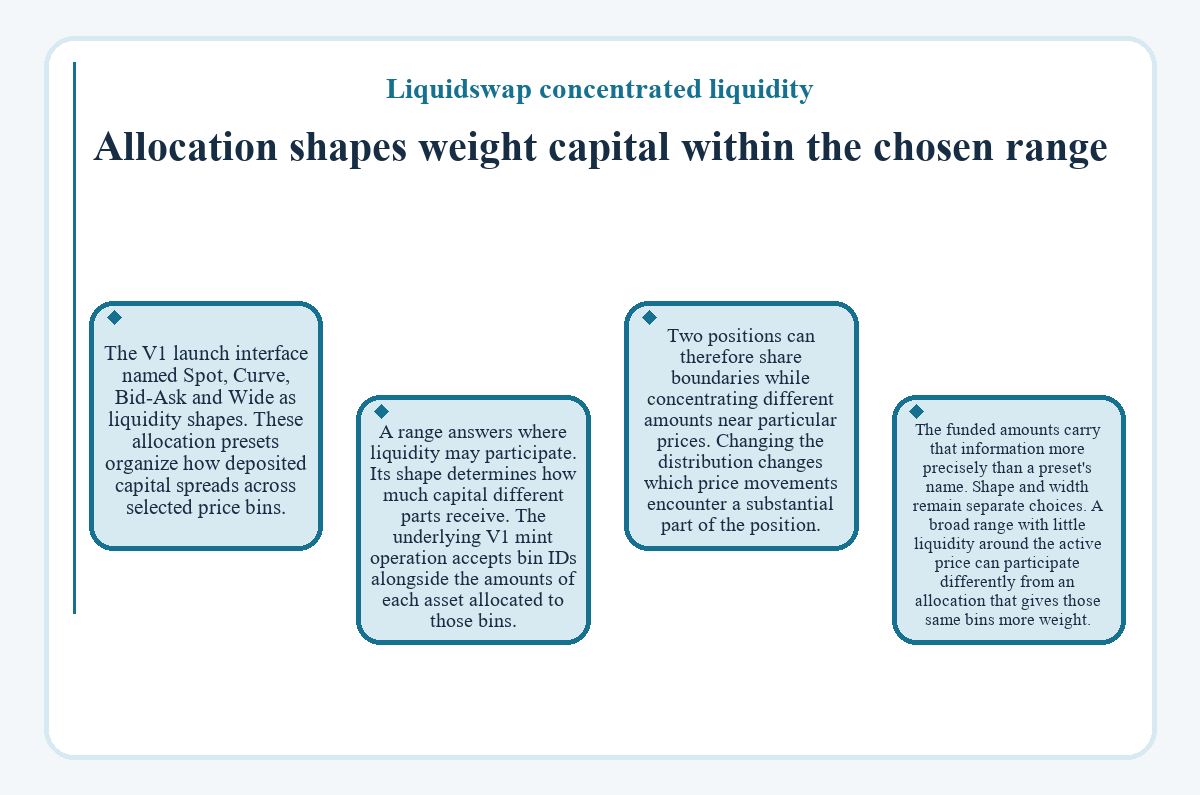
A range answers where liquidity may participate. Its shape determines how much capital different parts receive. The underlying V1 mint operation accepts bin IDs alongside the amounts of each asset allocated to those bins. Two positions can therefore share boundaries while concentrating different amounts near particular prices. Changing the distribution changes which price movements encounter a substantial part of the position. The funded amounts carry that information more precisely than a preset's name.
Shape and width remain separate choices. A broad range with little liquidity around the active price can participate differently from an allocation that gives those same bins more weight.
Does an idle bin lose its redemption claim?
An idle position retains a liquidity claim on its funded bins, even when they earn no new swap fees. Aptos V1 uses LB position tokens based on Aptos Token v1. A V1 LB token amount represents a provider's liquidity share in a specific bin. Redemption burns the supplied LB quantities and returns their share of the pool's current assets, including accumulated fees. Those assets can differ from the original deposit. Withdrawal still has to satisfy the applicable contract checks, including any minimum token amounts that the selected router enforces.
Retaining or replacing an idle allocation
Suppose an existing V1 position has funded bins away from the active price. Keeping the allocation preserves those bin holdings. Removing liquidity and allocating it to different bins changes where the position can participate. The replacement must fit the selected pool's accepted assets and the compatible entry point's execution limits.
The existing LB quantities identify the bin shares available for redemption. Current pool state and the compatible V1 router determine the accepted replacement.
| Allocation stage | Ownership or execution constraint |
|---|---|
| Read the existing allocation | Match the owned LB quantities to the intended pool, bin IDs and active bin. |
| Retain the bins or choose a replacement | Keeping the position preserves its existing prices. Replacement requires supported V1 liquidity operations. |
| Redeem selected shares if replacing them | Burn the selected LB quantities. Router minimums constrain the returned amounts of each asset. |
| Fund the replacement bins | The asset allocation must fit those bins. The router checks active-bin movement tolerance and minimum deposit amounts. |
| Inspect the resulting allocation | Compare the held LB quantities and bin IDs with the pool's active bin. A successful deposit does not establish subsequent fee income. |
| Allocation outcome | Retained liquidity stays in its original bins; accepted replacement liquidity follows its resulting bin allocation. |
Within its allowed tolerance, the V1 router adjusts requested bin IDs to match active-bin movement. The accepted allocation can therefore differ from the preview. The liquidity addition aborts if that movement exceeds the tolerance or a token minimum is not met. After an accepted addition, the resulting LB holdings establish the bins that were funded. Trading still has to use them. Retaining the original position remains a separate choice, with fee eligibility returning if swaps reach its funded bins again.
Does a fixed bin price protect the whole swap from price impact?
A swap that crosses price bins executes portions at different prices, even though each individual bin has a fixed price. Liquidity concentrated around the active bin can support more trading at that level. Once those reserves run out, other price levels determine the remainder. The amount available across the relevant bins therefore matters alongside the starting price.
A swap quote also accounts for fees. V1's router supports a minimum output amount that constrains acceptance, while insufficient pool liquidity can cause a swap to abort. The core V1 pool lacks the router's slippage checks. Fixed pricing within one bin does not remove those constraints.
Fee income and asset exposure measure different outcomes
An allocation can collect fees while losing value relative to holding its original assets outside the pool. Impermanent loss measures the effect of the changed token mix against holding the original tokens, before counting fee income. Concentrating liquidity makes more of the position available within a limited interval, so price movements through that interval can change its token mix substantially. Fee income belongs in the comparison, together with the value of the assets currently backing the position.
V1's volatility-sensitive swap fees do not promise to offset that difference. They affect compensation when liquidity participates in trading. Moving an allocation also incurs transaction costs and can require different token proportions. Repeatedly centering a position changes its exposure; it does not undo the earlier exchanges that changed its holdings.
One-sided bins can reserve liquidity for another trading price
Liquidity away from the active price can express a desired buying or selling level. The bin supplies its single asset at a defined exchange price. This makes an off-price allocation useful for positioning liquidity at a level where trading has not yet reached it.
That allocation remains part of an automated market maker. Trading through a bin changes its holdings, and subsequent movement in the opposite direction can exchange those holdings again. Its balance therefore needs to be understood as liquidity available for swaps, including the possibility of repeated crossings.
The same V1 bin framework also covers stable pairs. Smaller bin steps allow more closely spaced prices for correlated assets.
Everyday questions about Liquidswap concentrated liquidity
-
Can I transfer part of a V1 LB position to another account?
- V1 LB positions support transfers of all or part of their token amounts between accounts. The transferred amount represents liquidity in the same pool and bin; transferring it does not select new prices. The recipient holds that portion of the position, so dividing the token quantity also divides the associated liquidity claim.
-
Does V1's single-token withdrawal option include the active bin?
- The single-token withdrawal option in the V1 launch interface excluded the active bin. Its Remove Both option included that bin. Selecting one asset therefore did not mean converting the entire position into that asset. The selected redemption range and each bin's current composition determined which holdings the single-token option could remove.
-
How can I redeem only part of the liquidity in my V1 bins?
- Partial redemption uses the LB quantities that represent the selected share of liquidity. V1 position tokens have amounts tied to particular bins, so redemption can target less than the entire allocation. The returned assets reflect those bins' current holdings. Remaining LB quantities continue to represent the liquidity that was not redeemed.
-
Is an LB token necessarily unique because a wallet displays it with NFTs?
- A wallet's NFT display does not establish that an LB position is a unique, indivisible asset. Aptos V1 uses Aptos Token v1 assets with fungible amounts representing bin shares. Collection and bin identity describe the position, while its quantity describes the share. An NFT-style wallet category does not change that accounting.
-
Do I need a new V1 pool to choose a different price range?
- A different price range can use different bins within an existing compatible V1 pool. Selecting another range changes the allocation, while the pool retains its coin pair and bin step. Choosing different spacing requires a differently configured pool. In the Aptos V1 integration design, pool creation required permissions distinct from adding liquidity.
-
Why is an LB collection name insufficient to identify my V1 position?
- An LB collection name alone does not establish the identity of a V1 liquidity position. Different coins can share symbols that appear in a collection name. The pool ID and bin ID identify the intended allocation, and the collection's creator must match the protocol's minter account. Its token amount then describes the owned share.
-
Are testnet bin balances evidence of mainnet fee earnings?
- Testnet bin balances do not establish mainnet liquidity ownership or fee earnings. Aptos V1 has separate mainnet and testnet deployments, and its testnet integration uses test coins. A test position describes that environment's pool state. Production ownership and earnings belong to the corresponding mainnet position and its actual trading activity.
-
Can the V1 oracle show every past movement between bins?
- The V1 oracle stores sampled historical data rather than an unlimited record of individual bin movements. Samples include cumulative active-bin and bins-crossed values, which support calculations over retained history. Its sample storage cycles through a finite collection, so older data can be overwritten. An unfilled sample also cannot provide historical values.